
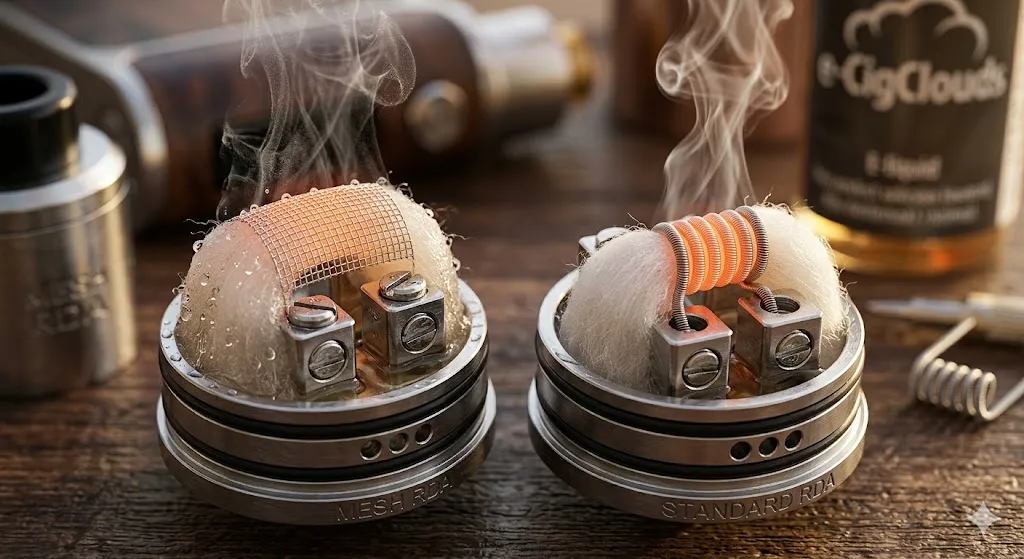
Anyone who has spent more than five minutes looking for replacement components has likely noticed a massive shift in how heating elements are designed. The classic wire wrap is no longer the default option. Instead, strips of metallic netting dominate the shelves. If you are trying to figure out how Mesh Coils vs Standard Coils stack up against each other, you are looking at the single biggest technical shift in hardware over the last decade.
Choosing the best vape coil type is about finding the right balance between heat distribution, battery life, and how you prefer to draw. Both designs have distinct physical traits that completely alter the character of your favourite e-liquid. Let’s break down how these two configurations operate, where they excel, and why one might suit your setup far better than the other.
Understanding the Hardware: Mesh vs Traditional Wire
To understand why they perform differently, we have to look at how they are built.
Standard Vape Coils
A traditional setup relies on a classic coiled wire spring, wound tightly into a neat cylinder shape. A piece of organic cotton is then pulled straight through the middle or wrapped around the exterior. When you fire your device, the power runs through the metal wire, heating it from the inside out.
Because a round wire has a relatively small surface footprint, the heat concentrates intensely along the thin metal strand. This creates a focused, punchy burst of thermal energy that relies heavily on a steady stream of airflow to pull the vaporised liquid away from the metal surface cleanly.
Mesh Coils
Rather than using a solid line of wire, a mesh design uses a wide, thin sheet of metallic grid or perforated metal ribbon. It looks like a microscopic piece of chainlink fencing rolled into a cylinder. The cotton wick wraps flush against this flat, broad screen.
This structural layout dramatically increases the amount of metal directly touching the liquid-soaked cotton. Instead of a single hot wire cutting through the middle of the wick, you get an even blanket of moderate heat covering a much larger surface area instantly.
Mesh Coils vs Standard Coils: Direct Performance Comparison
When evaluating mesh coil performance, it helps to look at the practical metrics that matter during daily use: flavour clarity, cloud density, power efficiency, and long-term durability.
Vape Flavour and Vapour Production
If maximizing your vape flavour and vapour production is your main priority, mesh holds a clear advantage.
Because the grid pattern spreads heat across a broad area, it vaporises a larger volume of liquid simultaneously without needing to reach scorching temperatures. This rapid, uniform heating eliminates cool spots and reduces the spitting common in older systems. The result is a highly saturated, incredibly crisp flavour profile and a dense, thick cloud volume.
Traditional standard vape coils offer a different sensation. Because they heat up from a centralized point, they tend to create a warmer, slightly more concentrated stream of vapour. While they might not match the sheer cloud volume or intricate flavour separation of a grid design, many purists prefer them for tobacco or complex dessert profiles where a warm, dense throat hit mimics traditional habits more closely.
E-Liquid Consumption and Battery Efficiency
There is always a trade-off for high performance. Because mesh variants vaporise a wider patch of liquid with every single press of the button, they naturally use up juice at a faster rate. If you choose a high-performance mesh setup, you will find yourself refilling your tank more frequently.
However, they are surprisingly efficient with your battery. Because the metal screen is incredibly thin, it requires less ramp-up time to reach its optimal operating temperature. Standard round wires—especially thicker gauges used in sub-ohm builds—take longer to heat up and cool down, which can drain your battery cells a bit faster at equivalent wattages.
Why Your Coil Burns in One Day (Real Reasons)
There is nothing more frustrating than fitting a brand-new heating element, filling up your tank, and finding it ruined by a harsh, acrid taste within twenty-four hours. When troubleshooting why your coil burns in one day, the blame rarely lies with a manufacturing defect. Instead, it usually comes down to small, easily correctable habit errors.
- Neglecting to Prime the Wick: The most common mistake is impatience. New cotton is naturally hydrophobic and needs time to absorb thick liquids completely. If you fire the device while the deep inner layers of the wick are still dry, the cotton chars instantly. Once scorched, that burnt taste will remain permanently. Always let a fresh setup sit in a full tank for at least five to ten minutes before taking your first puff.
- Aggressive Chain Vaping: Every time you take a long draw, the liquid inside the wick vaporises. The cotton needs a brief moment to draw more juice back into its fibres from the surrounding tank. If you take multiple deep draws in rapid succession, you dry out the core faster than it can replenish itself, leading to a nasty dry hit.
- Using Highly Sweetened E-Liquids: Sucrose and artificial sweeteners do not vaporise cleanly. Instead, they caramelise under intense heat, leaving behind a thick, dark, sticky residue directly on the metal surface. This process, often called “gunking,” forms an insulating barrier over the metal, causing it to overheat and burn the surrounding cotton within hours.
- Incorrect Wattage Settings: Every manufactured heating element has a recommended power bracket stamped on the side. Running your mod below the minimum threshold causes the liquid to pool and boil rather than vaporise cleanly, leading to flooding and spitback. Conversely, pushing past the maximum wattage dries out the cotton instantly, destroying the element.
Thanks to their uniform heat distribution, mesh variants are much less prone to localized hot spots, meaning they generally resist premature burning far better than traditional wire configurations, provided they are primed correctly.
+————————————+————————————+
| Mesh Coils | Standard Coils |
+————————————+————————————+
| • Massive surface area coverage | • Concentrated, central heat zone |
| • Instant, uniform ramp-up time | • Slower, warmer heating cycle |
| • Exceptionally crisp, open flavour| • Defined, warm throat hit |
| • Increased e-liquid consumption | • Economical juice consumption |
| • Excellent lifespan resistance | • Traditional, familiar draw style |
+————————————+————————————+
Choosing the Best Option for Your Setup
The right choice ultimately depends on your preferred style of inhalation and the type of hardware you use.
When to Choose Mesh
If you prefer an open, airy Direct-to-Lung (DTL) or Restricted Direct-to-Lung (RDTL) inhale, mesh is almost always the superior choice. It excels at extracting the subtle, bright top notes from complex fruit and menthol juices. If you want dense cloud production and an incredibly smooth, effortless draw, browse the latest selection of high-performance vape tanks to see how modern grid designs have revolutionized sub-ohm vaping.
When to Stick with Standard Wire
Traditional wire cylinders still hold a firm position in the Mouth-to-Lung (MTL) category. If you prefer a tight, restrictive draw that focuses heavily on a pronounced throat hit rather than massive cloud volume, a standard wire setup is ideal. They work beautifully with high-nicotine options and discrete pod systems, providing a familiar experience while conserving both juice and battery life.
To explore compatible options for your specific device, you can check out the comprehensive range of premium coils to find the ideal layout for your daily rotation.
FAQs
Which coil type lasts longer?
Mesh variants generally offer a noticeably longer lifespan. Because the electrical current distributes evenly across a broad grid, it avoids the intense, localized thermal stress that causes traditional round wires to warp, scale, and burn the cotton over time.
Do mesh setups use more e-liquid?
Yes. Because a larger surface area comes into contact with the wick simultaneously, more juice is converted into vapour with every puff. If you shift from a traditional configuration to a mesh setup at the same wattage, you will notice an increase in your fluid consumption.
Can I use nicotine salts with a mesh coil?
Yes, provided you choose the correct resistance level. While low-resistance sub-ohm mesh elements are built exclusively for low-strength freebase juices, many modern manufacturers now produce high-resistance mesh variants (1.0 Ohm and above) designed specifically to deliver smooth, flavourful nicotine salt draws at lower wattages.
Final Thoughts
When comparing Mesh Coils vs Standard Coils, there is no universal winner, but rather a choice of matching the right tool to your personal style. Mesh represents a massive leap forward for anyone chasing crisp, multi-layered flavour profiles, instant firing speeds, and robust cloud production. On the other hand, classic round wire options remain a reliable, highly efficient choice for vapers who value a tight, warm, and economical Mouth-to-Lung draw. Understanding how these designs handle heat and liquid allows you to fine-tune your setup to deliver the exact performance you want.
